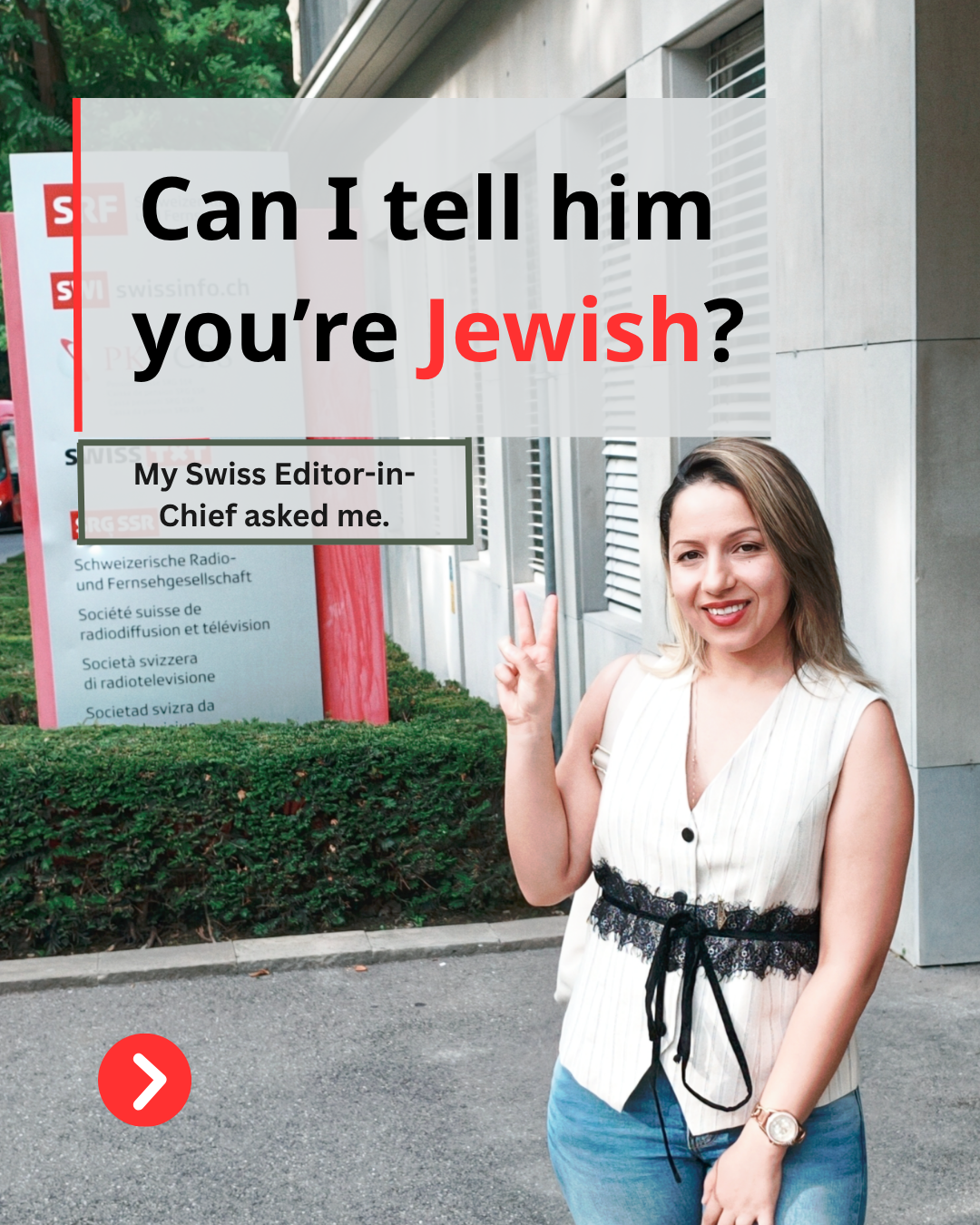
Today, I tell my story because I owe it to those who have not recovered and to those who were never given a voice in the first place. Because that is my duty as a journalist. (Amal Mekki, 18.08.2026, Bern)
“Can we mention that you are Jewish? I know this is very personal, but it would very much invalidate [journalist] Rickenbacher’s thesis.”
I received this message from Swissinfo’s Editor-in-Chief on 30 October 2024. By then, Israeli bombardment had killed more than 40,000 Palestinians in Gaza.
I was not Jewish. And my Editor-in-Chief knew that.
Only a few months earlier, he had given me Ramadan dates, knowing I was fasting.
A Jewish woman fasting Ramadan?!
No. I was what I had always been: a Tunisian, Arab, Muslim journalist, with a history, convictions, and a memory.
A little over a month later, on 2 December 2024, the conservative Swiss newspaper Neue Zürcher Zeitung published an article about me by Daniel Rickenbacher, a journalist supportive of Israel.
The article, which I consider a textbook case of “Cancelling by framing,” identified me by my full name, nationality, and religion, and built its narrative on three layers.
First: a sample of three interviews I had conducted, presented in a way that suggested they represented Swissinfo’s entire coverage of the proposed Hamas ban in Switzerland, and that this coverage reflected only views opposing or criticizing the ban.
Second: a selection of old social media posts of mine, published long before I joined Swissinfo — and even before I moved to Switzerland — expressing support for Palestine and for Palestinians’ rights to freedom, dignity, and to defend themselves and their land. From these posts, Rickenbacher concluded that “Mekki is not an Islamist. But she spreads a radical discourse that is mainstream in the Arab world”.
Third: his claim that I was “responsible for the majority of reports on the Middle East.”
The social media posts Rickenbacher cited were real. I have never denied them, and I still believe in the principles they expressed.
The other two points, however, were, in my view, misleading.
First, I was not the only Swissinfo journalist covering the Swiss government’s intention to ban Hamas. My interviews were only a small part of a broader body of coverage produced by other Swiss and European colleagues. But here is the crucial point: up until the publication of Rickenbacher’s article, Swissinfo’s coverage had, in fact, given space almost exclusively to voices that criticized, opposed, or warned against the ban.
So if there was an editorial imbalance, it was not “Amal’s coverage.”
It was an institutional editorial imbalance.
Second, as a journalist and Head of the Arabic department, I was in no way “responsible for the majority of reports on the Middle East.” That went far beyond my actual authority and responsibilities within the organization.
I asked Swissinfo to seek corrections on both points, in the interest of accurately informing the public.
I received no response on the first.
As for the second, the Editor-in-Chief told me it was merely a “nuance.”
A small difference.
And that is where the real question began for me:
When a journalist becomes “attackable,” as I would later be described, because of her identity and personal views — views that were not reflected in her journalistic work — does a false claim about the extent of her professional responsibility suddenly become a mere “nuance” for her employer, and for the public for the public whose money helps fund that very media institution?
My problem was not that a journalist supportive of Israel had criticized me, or even “defamed” me.
My problem was what happened when my identity and personal history were turned from private facts into professional evidence against me.
And, in my view, my own institution saw no problem in going along with that logic.
This is where Othering begins.
Decades before the genocidal war on Gaza, the Palestinian intellectual Edward Said wrote about how “the Orient” and “the Oriental” are not merely described, but produced as an Other: an object to be examined, doubted, interpreted. In my case — and in the cases of many journalists who have been silenced during this genocide and before it — the question was no longer: Did Amal respect journalistic standards in her reporting on the Middle East and Gaza?
Instead, it became:
Who is Amal?
What did she say years ago?
What cause does she carry with her, in her conscience, into the newsroom?
Does that not sound a little like an Inquisition?
Then came 6 December 2024.
That day, I entered a meeting with the Editor-in-Chief and the Head of Human Resources asking for two things: corrections to the false and misleading information in Rickenbacher’s article, and protection after he republished it on a pro-Israel website — one I personally consider part of the Israeli Hasbara ecosystem — this time accompanied by my photographs and personal social media accounts.
I would leave that meeting psychologically shattered.
While I was asking for the public record to be corrected and for my employer to protect me, I suddenly found myself being “questioned” by HR about an internal accusation from a colleague in the Arabic department, alleging that I had been “mixing activism and journalism” since joining Swissinfo.
It was an accusatory email I had never heard of.
I had not been given a copy before the meeting.
I was not given one during the meeting either.
And, crucially, it had been sent to management just two days after Rickenbacher’s article was published.
Even more importantly, Swissinfo had found no breach of its editorial standards in any of my published work since I joined the organization.
In the Editor-in-Chief’s own words, in an email dated 31 October 2024: “I myself had to give a confirmation to the SBC General Manager that all the articles you wrote are in line with our editorial standards – which I had no problems giving”.
In the same meeting, I was also told that another colleague from the Arabic department had described me, after Rickenbacher’s article, as “too scary to speak to” in relation to what I understood to be my emotional response to the genocide unfolding in Gaza.
And in that same meeting, the Editor-in-Chief told me that “because of who you are” you should have distanced yourself from the expression “Israeli occupation”.
I objected that under international law, and according to Switzerland’s own position, the Palestinian territories are occupied. I also pointed out that my own Swissinfo colleagues routinely used the term.
Yet I, specifically, was expected to distance myself from it.
“Because of who I am.”
Until then, I was not aware of any documented complaints from colleagues in the Arabic department — or any other department — about my articles or management.
Only days before Rickenbacher’s article, my team and I had been doing what we usually did: talking about life, our Arab countries, Gaza, the war; sharing what I believed was a common Arab grief; eating couscous and Nabulsi knafeh; laughing together in the staff restaurant.
So the accusations didn't hurt me only professionally. They were personal too.
This is where what I call “Arab abandonment” entered my story — not as a judgment on us, Arabs, as a people, but as a painful question about our place, as Arabs, inside dominant institutions.
What do we do when the identity of one of us becomes a liability?
Do we defend one another’s right to have a voice, an identity, a cause?
Or do we rush to prove that we are not like them?
Those were the facts.
My reading of them is something else.
My reading is that Swissinfo, which before Rickenbacher’s article had considered whether an imagined Jewish identity might protect me — and protect the institution — later treated my actual Arab and Muslim identity as a reason for imposing an additional standard of caution and professional distance on me.
To me, that is not neutrality.
Nor objectivity.
It is a double standard.
And I see it as discrimination based on identity.
In telling this story, I think of Frantz Fanon and Black Skin, White Masks. Not as an insult directed at those who choose assimilation, but as a question:
What does the center of power demand from the non-white person before they can be considered “professional” and “objective”?
How far must the non-white person distance themselves from who they are?
And when does assimilation become conditional upon self-denial?
I think, too, of Malcolm X and his harsh metaphor of the “house Negro” and the “field Negro.”Not to assign those labels to individuals, but to understand how structures of power can make the subordinated compete for proximity to power — even when that means becoming instruments for disciplining one another.
And from the French postcolonialism context comes another expression: the “Arabe de service”, summoned whenever an institution needs an “Arab voice,” only to be placed back inside that box once the task is done.
So my question today is broader:
Is an Arab in a Western newsroom allowed to be a complete journalist?
Or is she expected to be a useful Arab:
with her edges removed,
presentable,
reassuring to the center of power?
I do not know other people’s intentions. I do not claim to.
I know only what happened to me, and what the documents say.
My psychiatrist diagnosed me with a severe work-related depressive episode and identified the meeting of 6 December 2024 as a causal factor in the acute psychological breakdown that occurred during and after it.
I subsequently underwent psychotherapy and psychiatric treatment, including Eye Movement Desensitization and Reprocessing (EMDR) to process the impact of traumatic events, as well as antidepressant medication.
I never returned to work at Swissinfo after the meeting of 6 December 2024. I remained on medical leave until the organization terminated my employment, and I was formally free of that employment relationship at the end of July 2026.
This is only one part of my story.
I tell it today, as we mark the third year of the genocidal war against our people in Gaza.
I tell it having recovered and regained my voice, because I owe that to those who have not recovered — and to those who were never given a voice in the first place.
Because that is my duty as a journalist.
But my story is not a story of illness. It is a story of power.
The power to define “objectivity.”
The privilege of being allowed a cause without it being used against you.
Who is allowed to grieve the dead, and who is required to demonstrate distance from that grief.
Who is allowed to be angry, and whose anger becomes evidence against them.
Who gets to call an occupation an occupation, and who is told to distance herself from the word “because of who she is.”
That is why, when I return today to the email my Editor-in-Chief sent me on 30 October 2024, I understand more clearly what that question meant to me.
“Can we mention that you are Jewish?”
My answer, of course, was no.
Before adding, with some irony:
Sorry. It seems I belong to the “wrong kind of Semite.”
The Arab kind.
Long live a free Palestine.
07.10.2026- A testimony by Amal Mekki, former Beat Reporter and Head of the Arabic Department, Swissinfo. For two years, Innsane co-founder Amal Mekki remained silent about this story. Now she is sharing part of it: the story that would eventually lead to the founding of the Institute for Narrative Studies and Representation. The why behind Innsane.
(English translation from the original Arabic)
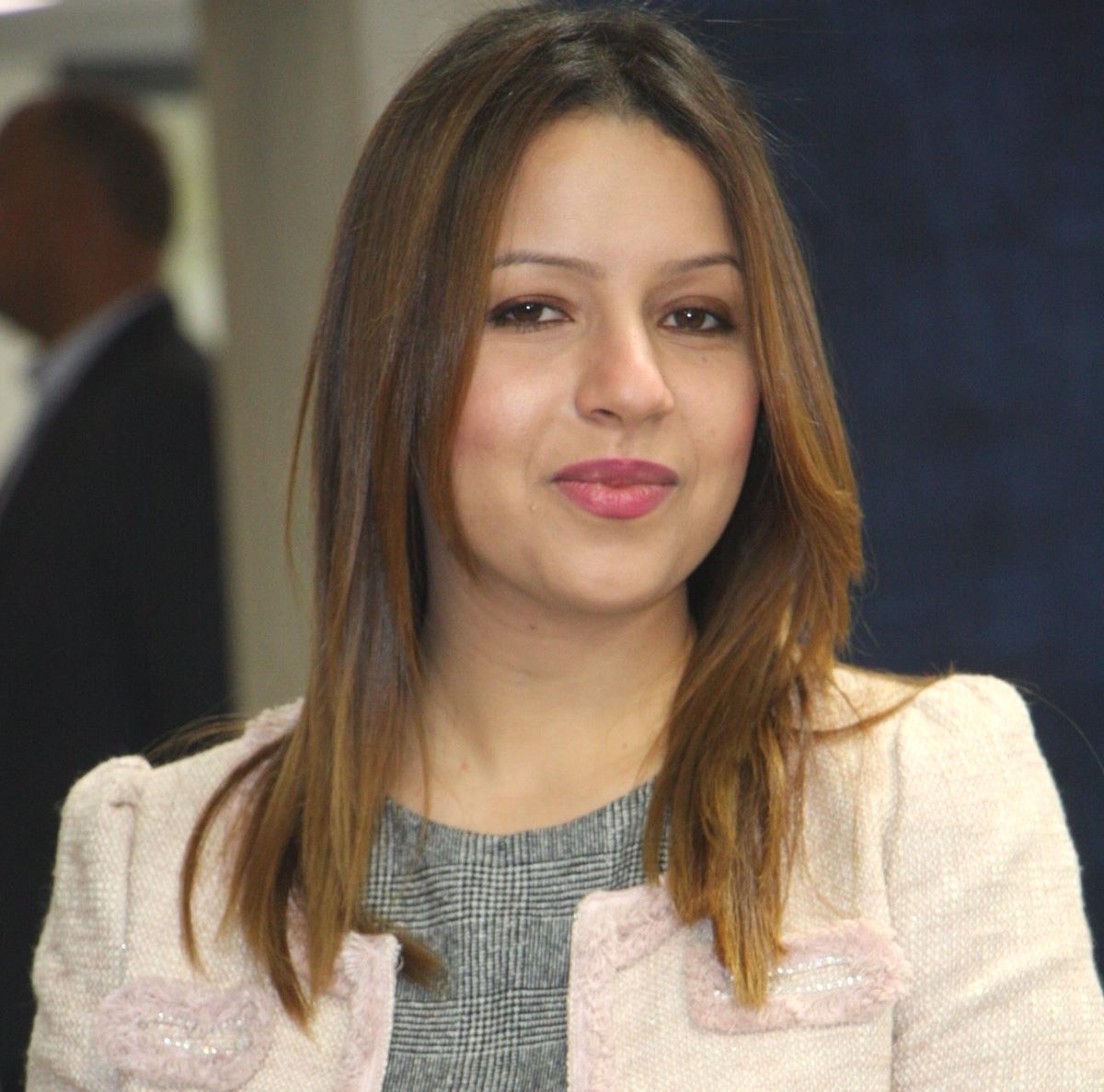
Journalist, Media Trainer & Researcher
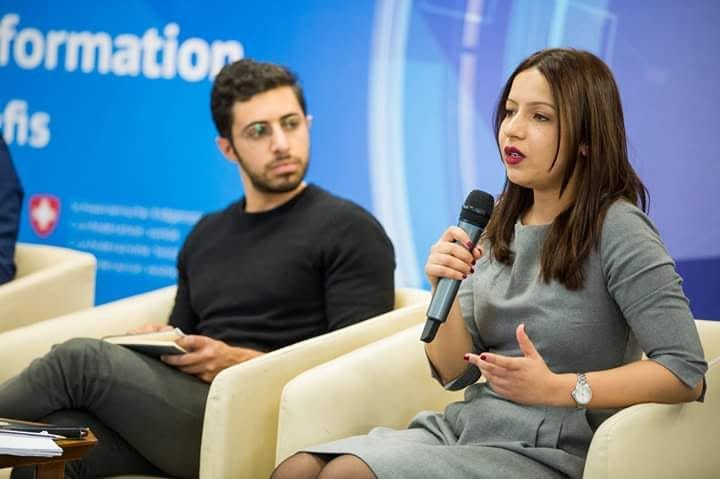
I'm an Arab and Muslim Tunisian journalist based in Bern, Switzerland. I work at the intersection of journalism, human rights, and media representation. Through reporting, research, and training, I explore how narratives shape public understanding and whose voices are heard.
"Because of who you are you"
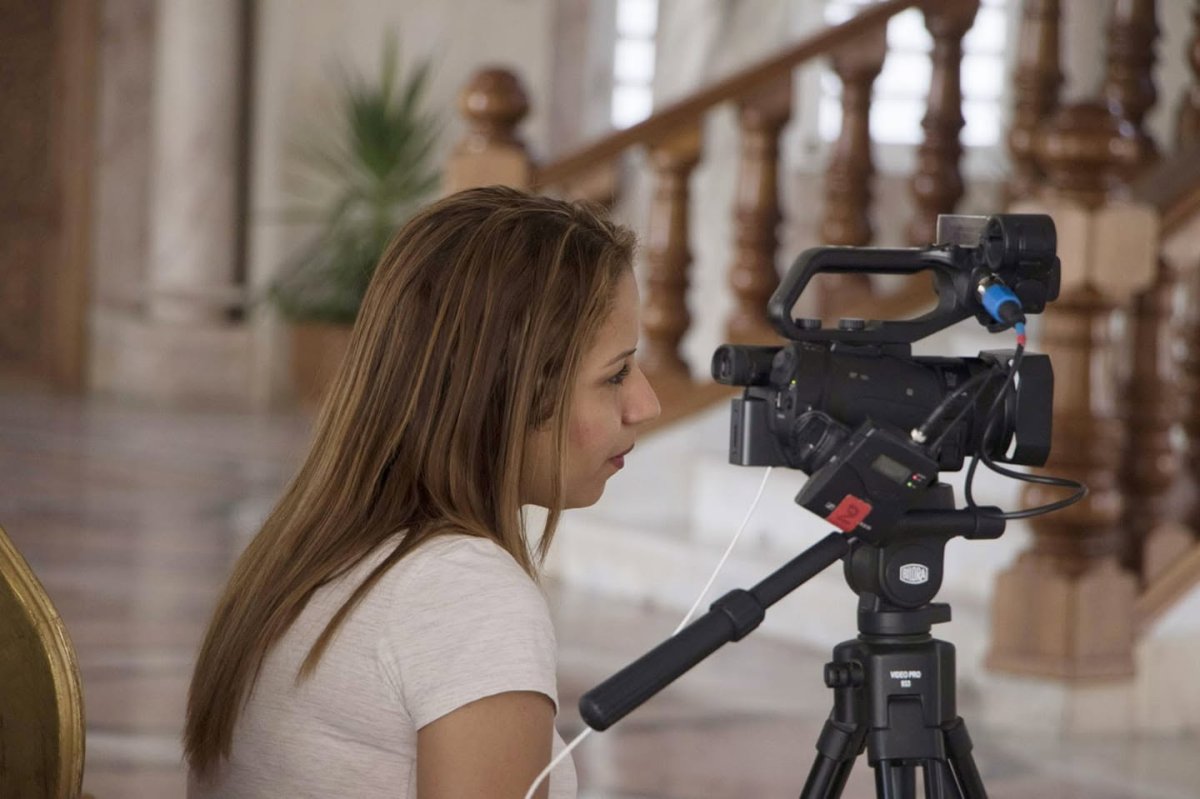
I report and write on foreign affairs, human rights, migration, and the Mashreq and Maghreb, with a strong focus on context, power, and representation.
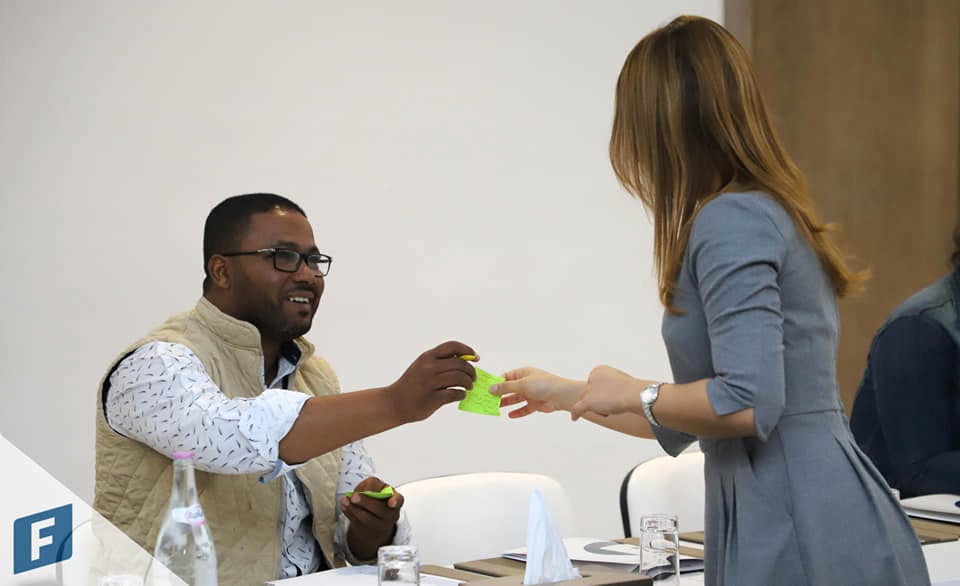
Media Trainer
I design and deliver training on reporting, storytelling, media representation, and journalism in complex or sensitive contexts.
Researcher
My research examines journalism, media framing, migration and displacement, coloniality and the politics of representation, combining critical theory with empirical analysis.
What participants say
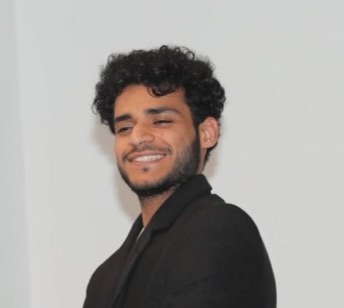
The intensive training and workshops I did with Amal Mekki on migration and human-interest journalism gave me tools that fundamentally changed the way I work. While I was based in Tunisia covering Libyan and Tunisian affairs, those workshops sharpened my narrative writing and pushed me past surface-level coverage, teaching me to dig into the real heart of a story and its human dimensions. Now, here in Canada, I’m drawing on those same skills as I engage with Indigenous communities, the broader Canadian public, and newcomers alike, exploring questions of land, identity, and shared memory through storytelling that actually resonates. That continuity, I think, is the clearest proof of what that training gave me: the idea that a journalist is, at heart, a cultural bridge carrying people’s stories with them wherever they go.
Salah Ali
Libyan journalist, Canada
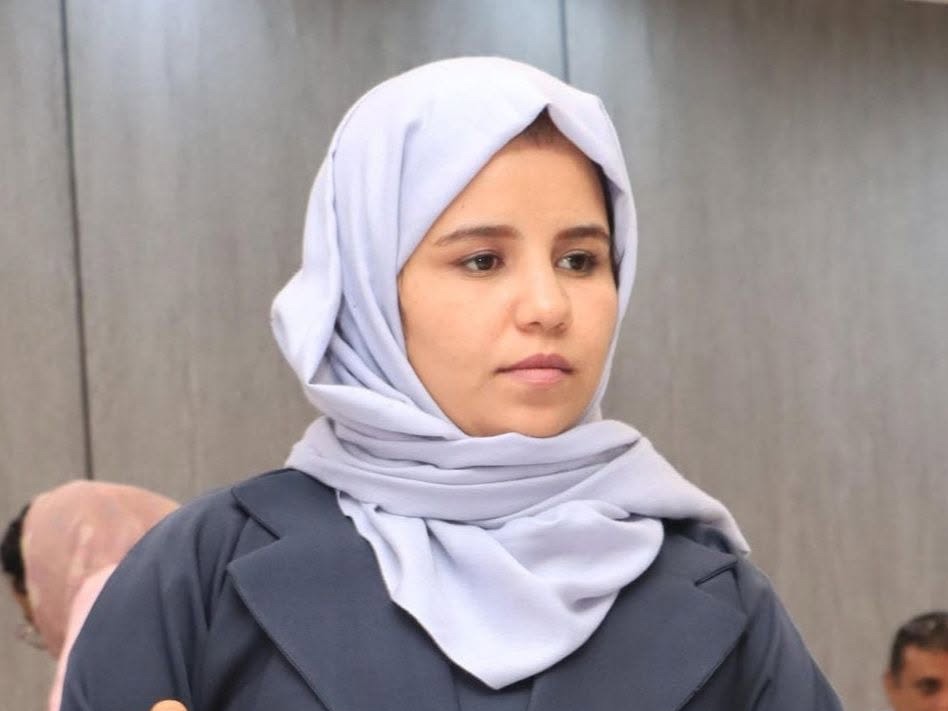
I met journalist Amal Mekki at the beginning of my career, and her guidance profoundly helped refine my professionalism and journalistic skills. I am forever grateful to Amal.
Samah Emlak
Yemeni journalist, Yemen
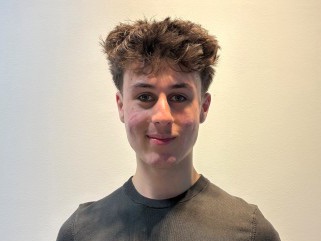
Great session with trainer Amal MEKKI at the Polit-Forum Bern (on "How to speak to the media"). If you work in policy and ever face a mic, go find her.
Kemal Imeroski
foraus volunteer, Switzerland
Stay connected with Innsane
Institute for Narrative Studies and Representation